I'm Suspicious of Practice Exams. I Built One Anyway
I'm Suspicious of Practice Exams. I Built One Anyway
When I work with people preparing for their IC&RC credentialing exam, I give them a warning that tends to surprise them: be careful with practice exams. In my experience, when a question shows up on a practice test, it guarantees exactly one thing: That question will not be on the IC&RC exam.
I don't write that to be clever. I write it because I have watched too many well-prepared candidates get rattled by practice material that did them more harm than good.
The Problem With Most Practice Exams
Here's the problem. The IC&RC puts its questions through a rigorous process. Every item is tested for validity, bias, and accuracy. Items that don't perform get cut. Most practice exams do none of this. They are written quickly, rarely reviewed, and almost never validated. So a fully prepared candidate sits down, meets a sloppy question with two defensible answers, and starts to doubt everything they know.
That’s what I call sabotage!
The Deeper Problem Is How We Use Them
There is a deeper issue too, and it has to do with how we use these tools. A practice exam is not a training montage. Grinding through hundreds of questions, checking your score, and running it back is one of the least efficient ways to learn this material. You memorize the quirks of a particular question bank instead of building the clinical judgment the credential is meant to certify. You feel productive because the number goes up. But the IC&RC is not testing whether you can recognize a question you have seen before. It is testing whether you can reason.
The Case That Pushed Me Over the Edge
So for years I was the guy telling people to be skeptical of the very thing they were reaching for. But one case in particular put me over the edge and made me do something about it. I had a client, fully prepared and ready to take the ADC exam. About a week before the exam, he took a popular (and expensive) practice exam, and it absolutely screwed him up. He lost his confidence, and felt like all the work he'd put in was for nothing.
It wasn't an IC&RC practice exam, so he still had access to it. I had him go over the questions and answers with me in our coaching session. All I can say is, OMG, it was horrible! Most of the questions he read to me made no sense whatsoever. They were deliberately confusing, used distracting language, and seemed designed to trick you. Even worse, the exam that he paid for and downloaded in 2026 contained content that was out of date in 2006!!
I've been using practice exam questions in my coaching for the past six months, and I've generated hundreds and hundreds of questions. I have a complete curriculum I designed nine years ago that I am slowly turning into CEU courses (coming soon). I also have my YouTube channel with quite a few videos on exam preparation, so I have plenty of good material to build practice exams from, but I've been dragging my feet. However, after sharing his experience with me, I knew I had to take some sort of action. Like, just get it posted!
After about a decade of watching people suffer from taking bad exams, it was time to finish my own. And here it is.
What I Actually Built
What I made is not just a quiz. It's a study tool shaped like a practice exam. Yes, there are 150 questions, and yes, you should take them. But the real value is in what comes after. For every single item, I wrote an extended explanation of why the correct answer is correct and why each of the three distractors is not. I didn't settle for telling you an option is incorrect. Here’s an example:
Ite
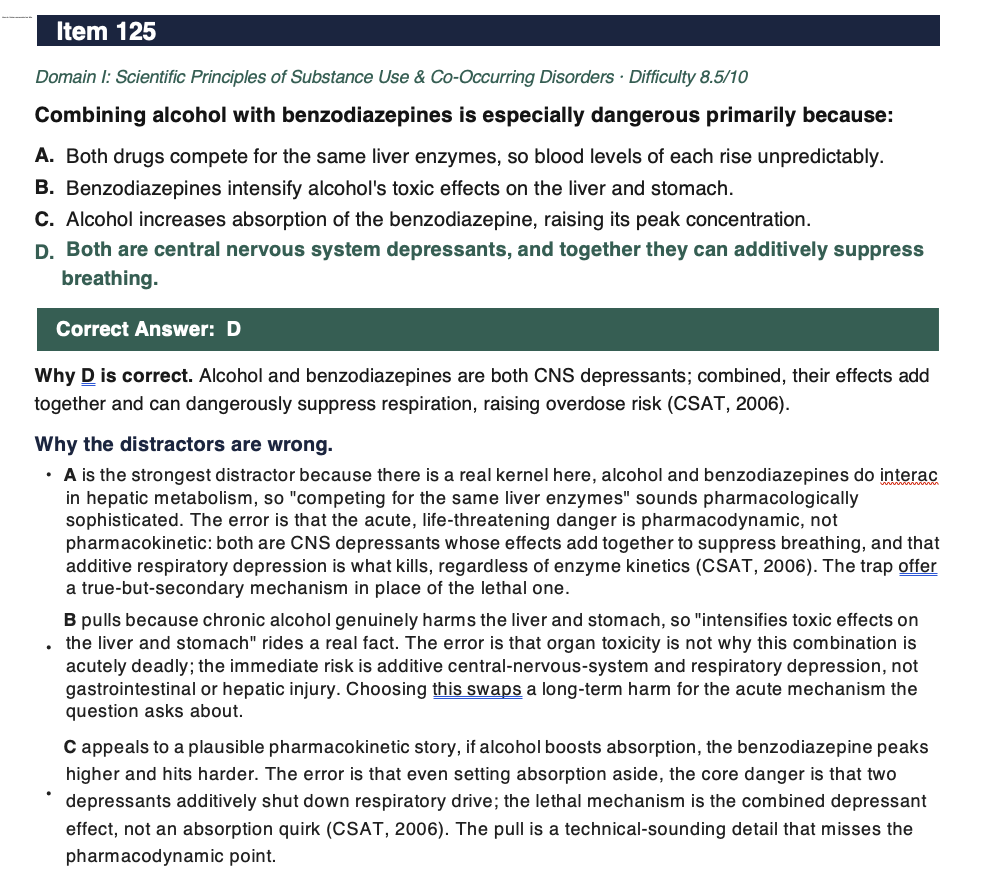
m125
Why the Distractors Are the Point
A distractor is worth studying precisely because it is tempting. So I explain why it pulls at you, or when it would in fact be the right call in a different situation. That is where the learning lives. The moment you understand why a strong answer is wrong here but right somewhere else, you can build the clinical judgment you can apply to any question the IC&RC puts in front of you.
The Difficulty Ramps Up As You Go Along
I didn’t try to emulate the IC&RC ADC exam (that’s not really possible). Instead, I ramp the practice exam up in difficulty as you take it. The early items are easy, and the difficulty ramps steadily as you go. The advanced version, written for the AADC (coming soon), asks more of you than the entry-level exam. It tests application and clinical reasoning, not recall, so I wrote scenarios that make you think through a case the way a real client presents, not fill in a definition.
Free Updates, Forever
I also have maximum flexibility. Because I control the content 100%, I can update the exam whenever I want. Especially when a few people point out that a question might not be ideal. Even better, when I do update the exam, you get to take the new version without paying any more money!
Please note: I'll have more exams published over the next few weeks. Those are still at the regular price. But once you buy an exam, you get the update for that specific exam.
Yeah, I'm serious. You can take the exam as many times as you want, and when I update it, you get the updated version without paying one penny more.
A Bibliography That Sends You Somewhere
I also included a bibliography, and this matters more than it sounds. When an explanation exposes a gap in what you know, I want you to have somewhere to go. Most of those sources are free and come straight from SAMHSA, NIDA, and the current clinical literature. The exam shows you where you're weak, and the reading is right there to fix it. That back-and-forth is the part that actually works.
How to Use It
Here is how I would use it. Take the exam first, cold, without the answer key in front of you. Sit with the discomfort of not knowing. Then open the explanations and read every one, including the items you got right, because knowing the correct answer for the wrong reason is its own kind of risk. Rank your weak domains. Do the reading. That is the whole method.
What It Is, and What It Isn't
I want to be clear about what this is and isn't. It will not predict the questions on your exam. Nothing can. What it will do is sharpen the reasoning underneath your answers, and that's what you carry into the testing room. But I've done my best not to give you any trick questions, and they aren't focused on obscure trivia that is not likely to be tested on the real thing. As always, I focus on the fundamentals!
I have seen a lot of practice exams over the years, and I built this one to be the antidote to most of them. I hope it's useful to you. And I hope it leaves you a little more skeptical and a lot more prepared.
-Scott Spiers, MA, CCS, LCAS, CPC
Ready to find out where you stand? Take the ADC Practice Exam →
